
However, masters degree with National Eligibility Test or PhD would continue to be the minimum eligibility criterion for direct recruitment in colleges, a senior official said.
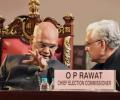
For successive governments the Election Commission remains a 'holy cow', where unhealthy precedents are allowed to be nurtured since Independence, says N Sathiya Moorthy.
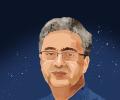
Ravi Sinha is described as "highly tech-savvy", and credited with infusing modern technology in the field of intelligence collection.

'I am doing all this for the students of Kerala, and when they come and hit me, it is very frustrating.' 'My regret is that something that could set off for the future has been thwarted.' 'We have not changed the syllabus for decades, we have not accepted norms in education and technology is hardly used. Today's students are studying what I studied decades ago.'
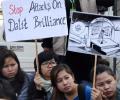
'Teachers discriminate among students based on caste, religion and gender,' says Dr Rajesh Paswan, an associate professor at JNU.

'I do not want to get into the number game. This time, the BJP will get unprecedented seats and vote percentage in Gujarat.'

'My wife has done everything... She has had to give up a lot,' HRD Minister Prakash Javadekar tells Sahil Makkar.
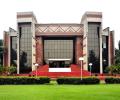
The one-size-fits-all approach adopted by the AICTE is not suitable for regulating business schools in India, argues Asish K Bhattacharyya.
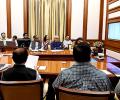
The appointment of new expenditure secretary comes a month-and-a-half ahead of the Budget for 2020-21 to be presented on February 1.

Cloned journals have become more rampant in the post-pandemic world.

Ajit Balakrishnan on how to arrest a worldwide decline.

Is it just the glamour?
'Indian universities are giving out PhDs without adequate evaluation,' charges Dr Satya Narain Jatiya, MP.

The real battle for NEET abolition can take much more time and energy, observes N Sathiya Moorthy.

'Imagine for a soldier -- first you conquer territory after fighting a fierce battle, suffer casualties and then you are ordered to come back to your side of the International Border in India.'

What does Nobel Laureate Abhijit Banerjee thinks about India's education sector?

Indians are more vulnerable to technology support-related scams compared to the global average, and lost over Rs 15,000 on average in such scam, a Microsoft research has found. According to the 2021 Global Tech Support Scam Research report, which looks at tech support scams and their impact, consumers in India experienced a relatively high scam encounter rate of 69 per cent during the past 12 months, close to the 70 per cent rate experienced in 2018. In contrast, there was an overall five-point drop in scam encounters globally with a rate of 59 per cent over the same period. The survey was conducted in Spring 2021 and asked consumers to share their experiences with tech support scams for the year prior (January 2020 to present).
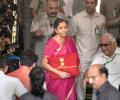
As India emerges from the COVID-19 crisis, the ninth budget under the Modi government, including an interim one, is widely expected to focus on boosting spending on job creation and rural development, generous allocations for development schemes, putting more money in the hands of the average taxpayer and easing rules to attract foreign investments.
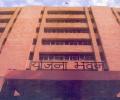
The Planning Commission, which was established in 1950, will be called 'Neeti Ayog' in its new avatar, months after Prime Minister Narendra Modi announced that it will replaced by a new body.
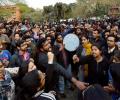
The State is trying to curb the students movements, therefore, there are suspicions against some of the Subramanian report on education's recommendations, says Mohammad Sajjad.
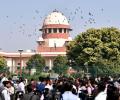
Tamil Nadu's unending legislative fight for exemption from NEET has now flagged the question if it's time to review the Supreme Court's famous verdict in the 'Mandal case', fixing 50-per cent upper-limit for all reservations, asks N Sathiya Moorthy.
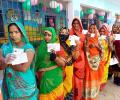
'Economic issues do not matter during elections; it is the emotional connect that helps swing votes.'

Attorney General K K Venugopal told a bench headed by Justice Bobde that the Constitution (103 amendment) Act, 2019 granting 10 per cent reservation to EWS is intended to uplift around 200 million people who are still below the poverty line.

One should appreciate the sagacity and audacity of JRD and Nani Palkhivala in founding TCS on April 1, 1968. At that time there was no Microsoft or Intel, SAP or Accenture, much less Google.
They needed a person who could build and execute their vision: A frontiersman; a problem solver and an institution builder. It was their and India's good fortune that Faqir Chand Kohli more than measured up to their requirements and indeed laid the foundation to take TCS to unimaginable heights and to the giant success that it is today. Shivanand Kanavi salutes the incomparable F C Kohli, who passed into the ages last week.

'Having dedicated my life towards improving breast healthcare in my motherland. I shall continue to work with rock-solid determination following this "chosen" path.'

The Indian Institute of Science topped the HRD ministry's 2017 national rankings. In 2016, the IISc was ranked among the world's top 15 universities in the Times Higher Education University Rankings. In his book The Creation of Wealth: The Tatas from the 19th to the 21st Century, R M Lala recounted how Jamsetji Tata's grand vision and immense personal contribution laid the edifice of arguably India's finest educational institution.

Finance Minister Nirmala Sitharaman on Monday presented the Budget for 2021-22 in the Lok Sabha that is expected to provide relief to the pandemic-hit common man as well as focus more on driving economic recovery through higher spending on healthcare, infrastructure and defence amid rising tensions with neighbours, As India emerges from the COVID-19 crisis, the ninth Budget under the Modi government, including an interim one, is widely expected to focus on boosting spending on job creation and rural development, generous allocations for development schemes, putting more money in the hands of the average taxpayer and easing rules to attract foreign investments.
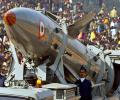
The 'Make in India' concept in the defence sector has the potential to help India meet 70 per cent of its defence needs in a few years.

Indian roads are far more unsafe than its railways. A sense of urgency is required to tackle India's embarrassing record on road safety.
'Karpoori Thakur must be remembered by people today who are tired of witnessing fractious politics where corruption, bigotry, hatred and violence seems to have become distressingly recurrent,' says Mohammad Sajjad.

Here's the full text of President's Ram Nath Kovind's address to the joint sitting of both houses of Parliament on the first of Budget Session 2022.

Unlike the regimes of Jayalalitha, Palaniswami and Karunanidhi, ministers are actually getting to make decisions on their own, with the unmentioned rider that they would be held responsible and accountable, observes N Sathiya Moorthy.

British Prime Minister Theresa May will be in India tomorrow, but Cyrus Mistry will no longer head the Indo-UK CEO forum.

In a few years from now, India will be looking at an entirely different type of military adversary across the borders, in our waters, in the air, in space and in our communication networks, says Nitin Pai.
.jpg)
We present Prime Minister Manmohan Singh's full speech as he addressed the country on the occasion of 66th Independence Day, from Red Fort, Delhi.

In the midst of huge job losses as a fallout of the coronavirus pandemic, Tamil Nadu Chief Minister Edappadi K Palaniswami has signed 17 MoUs for an investment of Rs 15,100 crores that aim to provide 47,100 jobs. But a clearer picture on where the projects stand will emerge only after the Covid-19 induced fear psychosis ends, to see if popular protests will derail them like they have done so many others, says N Sathiya Moorthy.

One hopes the higher courts take the extraordinary steps needed to secure justice for the victims. The Gujarat carnage demands nothing less because of its unique nature and sponsorship by the State, argues Praful Bidwai.

The Union government is keen to ensure financial security for unorganised sector workers

Indian economy about to take-off

The Supreme Court and its committees, the two states and the central government must become objective and take the present and not just the past in mind.
